
Camp Half-Blood. Riptide (the pen that turns into a sword). The lift up to the 600th floor of the Empire State Building. Annabeth, Grover (the satyr with serious anger issues).
If you’re here looking for what to read after Percy Jackson, your child has probably torn through the five originals, maybe Heroes of Olympus too, and now wants more of whatever that was. They’re in extremely good company. So consider this my list of books to read after Percy Jackson, built for exactly that child.
Even when I was teaching (a few years after the books were published), these books still had a huge fan base.
And the kids obsessed with the books (think orange T-shirts. Pen lids uncapped dramatically across the classroom) would get into long arguments about whether Poseidon would beat Zeus in a fair fight (he wouldn’t, sorry).
It’s the kind of series a kid carries with them.
So if you’re after the next thing in that lane, the after-PJ shelf is one of the best bits of fantasy going.
What Percy Jackson actually delivers
These books do have it all. From Greek gods walking around modern Manhattan like they own it to Percy’s Latin teacher Mr Brunner turning out to be Chiron, a centaur in a wheelchair.
Not to mention a ballpoint pen that uncaps into a three-foot bronze sword called Riptide and Medusa running a roadside garden gnome shop.
Then there’s Percy. Twelve, dyslexic, ADHD, kicked out of six schools, and telling you the whole thing himself in proper kid sarcasm.
And the friends. Annabeth and her Yankees cap that turns her invisible. Grover the satyr on his fake crutches at school. Chiron back at camp. We meet Percy in book one with no mates and he ends the series surrounded.
This could be why your child has read all five and is now asking what’s next (don’t worry, I think you’ll find something here).
What to look for in an after-PJ book
A handful of things to consider when you’re picking the next one.
Mythology, made modern. PJ uses Greek myth, but it doesn’t have to be Greek. Norse, Slavic, Egyptian, invented from scratch. As long as gods or monsters are showing up somewhere, it counts.
A first-person narrator. Percy tells you the story himself, chatty and sarcastic, right in your kid’s head from page one. A book in chilly third-person (the kind that opens with a page about the weather) is going to feel like a slower read.
Cliffhanger chapters. PJ does not give you a quiet ending to chapter three. The next book should not either.
A long run. Five PJ books, then five Heroes of Olympus, then Kane Chronicles, then Magnus Chase. The next series needs to have somewhere to go.
Five fantasy books to read after Percy Jackson
Five books to reach for. They all sit somewhere in PJ’s lane (mythology, voice, big stakes, or all three).
Impossible Creatures by Katherine Rundell
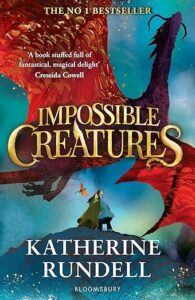
Impossible Creatures
Christopher discovers a passage to the Archipelago, a cluster of hidden islands where every mythical creature still lives. Griffins, dragons, sphinxes, centaurs, all of it. There he meets Mal, a girl from the islands with a flying coat, a baby griffin, and a killer chasing her.
Together they set out to discover why the creatures are dying, and why the world beyond the Archipelago is in danger.
This is the closest match to Percy Jackson. Mythology spilling into a modern world, two-kid team, and an epic quest.
Rundell won the 2024 Waterstones Children’s Book Prize for it. It might feel like a bit of step-up from PJ and probably best suited to confident 10-year-olds and up.
The Castle of Tangled Magic by Sophie Anderson
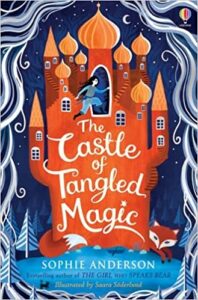
The Castle of Tangled Magic
Behind a magical doorway is a land where hope has been lost and a scheming wizard holds all the power.
Thirteen-year-old Olia steps through it. She’s the one chosen to save the place, with her new friends and family already in danger and the clock ticking.
After-PJ readers tend to chase a new pantheon. Riordan himself does it. Greek with Percy, Egyptian with the Kane Chronicles, Norse with Magnus Chase.
Sophie Anderson writes from Slavic folklore. Different gods, different myths, same quest type.
Great for readers at age 9+, so a comfortable fit for younger PJ readers too.
(Second-guessing an age fit? Our piece on how to tell what age a book is for sorts it.)
The Wizards of Once by Cressida Cowell
Wizards and Warriors are sworn enemies. Xar is a wizard boy who hasn’t come into his magic yet, so he heads into the forbidden Badwoods to steal some from a witch. What he catches instead is a Warrior girl called Wish.
The two of them end up at the dungeons of Warrior fort, facing an evil Queen, while something that’s been asleep for hundreds of years starts to wake up.
This is Cressida Cowell, who also wrote How to Train Your Dragon. Easier going than PJ, so a good fit if your child loved Riordan but found the books a touch dense.
This one also made our what to read after Harry Potter list. Full write-up over there.
The Secret of Platform 13 by Eva Ibbotson
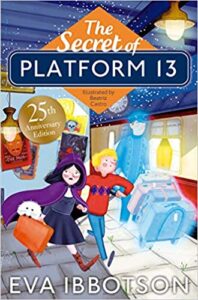
The Secret of Platform 13
Under Platform 13 at King’s Cross is a secret door that opens once every nine years. The last time it opened, a baby prince was stolen from a magical island. This time, four figures step through to get him back. A wizard, an ogre, a fey, and a young hag.
The prince is now Raymond Trottle. A horrible rich boy who doesn’t understand magic and is dead set against being rescued.
Ibbotson wrote this in 1994, three years before Philosopher’s Stone.
Eva Ibbotson also wrote Journey to the River Sea and The Dragonfly Pool. Worth a look if Platform 13 goes down well.
Skulduggery Pleasant: Books 1–9 by Derek Landy
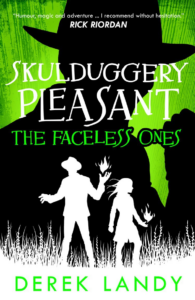
Skulduggery Pleasant
Skulduggery Pleasant is a detective. He’s also a sorcerer, a warrior, and a skeleton.
He picks up a 12-year-old apprentice called Stephanie, and the two of them spend nine books saving Ireland from rolling magical apocalypses.
Skulduggery and Percy are cut from the same sarcastic cloth. The regular-kid-meets-hidden-magical-world setup tracks too, just with a skeleton mentor instead of a centaur.
This is the bundle of books one to nine in one go. A child who likes Derek Landy is sorted for ages.
For when they’re ready for the next thing
Bartimaeus: The Amulet of Samarkand by Jonathan Stroud
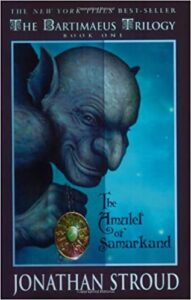
Bartimaeus 1 – The Amulet of Samarkand
Nathaniel is a magician’s apprentice in an alternate-history London where wizards run the country and djinn get summoned to do the dirty work. A hot-shot wizard called Simon Lovelace humiliates Nathaniel in public. So Nathaniel summons Bartimaeus, a 5,000-year-old djinni, and sends him out to steal Lovelace’s most prized possession, the Amulet of Samarkand.
What he gets in return is magical espionage, murder, rebellion, and a djinni who will not shut up.
The book switches between Nathaniel’s chapters (third-person, serious) and Bartimaeus’s chapters (first-person, sarcastic, with footnotes).
A meatier read than PJ. Bartimaeus wisecracks the same way Percy does, just with 5,000 more years of practice.
Age 11+, so pick this when your child’s ready for something with more bite.
A couple more worth a mention
For more first-person wit
Lemony Snicket‘s A Series of Unfortunate Events. The narrator warns you, repeatedly, that the Baudelaire orphans’ story is going to go badly. It does. Same dry-deadpan family as Percy’s narration. Nineteen titles in total.
What to read after Heroes of Olympus
A quick word for the child who didn’t stop at the original five. If they’ve marched through Heroes of Olympus as well, then what to read after Heroes of Olympus is really this whole page’s job, and every pick above holds up.
But Riordan isn’t quite finished with them yet. The Kane Chronicles trilogy (The Red Pyramid, The Throne of Fire and The Serpent’s Shadow) swaps the Greek gods for Egyptian ones, and Percy Jackson and the Greek Heroes is for the child who reads the myths themselves for fun. All four are in the library.
Where to start
If your child’s just finished Percy and still has the adventure bug, Impossible Creatures is the one to put in their hand. Closest fit to the Percy energy. Mythology spilling over, two-kid team, big stakes.
And if it’s the clever schemer they love more than the fantasy quest, our books like Artemis Fowl list goes the other way.
The Little Reads library has 3,000+ hand-picked books, the fantasy ones included. £7.99 a month after a 7-day free trial. Cancel anytime.
Worth saying: if reading is still hard work for your child, an app built around phonics and reading levels is the better buy. We’re made for kids who already devour books.
More after-series guides
If your child’s just finished one favourite series, we’ve got a few more lanes to send them down:
- Books like Skandar, for the kid who likes their unicorns dangerous.
- What to read after Roald Dahl, for the Matilda obsessive.
- Books like Warrior Cats, for the one who’d rather follow a clan of cats than people.