
Figuring out what books are right for your child’s age can feel like negotiating completion dates on a building project.
Like when your eight-year-old comes home clutching Artemis Fowl because their best friend’s big brother says it’s the best book ever written, and you’re squinting at the back cover looking for an age, any age, and finding nothing.
If your child loved Artemis Fowl, our piece on books like Artemis Fowl has five more to line up next.
Films get a rating slapped on the box. Games too. Books just… don’t.
So knowing how to tell what age a book is for ends up being a parent job, usually done in a bookshop with a child tugging your sleeve.
And even when you do find a number, it can be more cryptic than no number at all. You Google the title and get ‘appropriate for ages 7-10’. What does that mean? That a 7-year-old could read it but the content is more of a 10-year-old thing? Where do these ranges even come from, and who decides?
(We’ll answer that one in a sec.)
The good news is it takes about two minutes once you know what to look for. I’ve done it a thousand times as a teacher and I promise it’s not a dark art.
Below: the quick checks, plus straight answers on the books parents ask about most (yes, including the one in your kid’s book bag right now).
Why books don’t come with age ratings
There’s no official rating system for children’s books. Nobody sits in an office deciding Artemis Fowl is a 10.
Some publishers print a band on the back, “9–12” if you’re lucky. Most don’t. And even when the number is there, it only answers half the question.
Because there are really two questions. Can my child read it? And should they?
The first is about reading level. Word length, sentence length, how much help they’d need.
The second is about content. A book can be written in lovely simple sentences and still be about war, death or heartbreak. The number on the back rarely warns you about that bit.
The checks below cover both.
How to tell what age range a book is for: five quick checks
1. Read one page from the middle
Not the first page (authors polish those to within an inch of their lives). Open it somewhere random and read a paragraph.
Would your child stumble on more than five words on that page? It can wait a year. Or would they breeze it? It’s a green light on the reading level.
2. Find out how old the main character is
Kids read up. The hero of a children’s book is almost always a year or two older than the child it’s written for.
Artemis Fowl is twelve, and the books suit confident nine and ten-year-olds. Tracy Beaker is ten, and eight-year-olds adore her. It’s not a perfect rule but it’s a wayyy better guide than the cover art.
3. Check the themes, not just the words
This is the one parents skip, and it’s the one that can catch you out.
Easy sentences can carry heavy stories. A book your child can read fluently at eight might still hand them a dead parent, a war or a moral problem they’re not ready for. Flick to the blurb and ask what actually happens in this story, not just how hard the words are.
(I’ve got an example below that shows exactly what i mean.)
4. Watch out for series that grow up with the reader
Series age with their heroes. Harry Potter starts as a book you’d hand a nine-year-old and ends somewhere much darker. I’ve taken that one book by book in what age are the Harry Potter books suitable for.
Ruby Redfort does it too. Book one suits an eight-year-old, and by the later books she’s a thirteen-year-old secret agent dealing with thirteen-year-old problems. Book one being fine doesn’t mean book six is fine. Check where the series ends up, not just where it starts. Alex Rider is the classic case, and I’ve answered what age are the Alex Rider books for in its own guide.
5. When in doubt, look it up
If the publisher’s page doesn’t help, the answers to the most-googled ones are below. Bookmark this bit for the next school-fair impulse buy.
The books parents ask about most
What age is Artemis Fowl for?
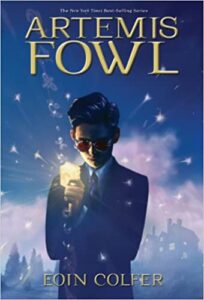
Artemis Fowl
Artemis Fowl is a twelve-year-old criminal mastermind. He discovers a hidden world of armed, high-tech fairies, kidnaps one of them (Officer Holly Short) and holds her to ransom to rebuild the family fortune.
It sounds dark written down like that. On the page it’s more tame. Gadgets, heists and a boy genius being outsmarted by his own plan, closer to child-like James Bond than anything nasty.
The violence is cartoonish and the cleverness of Artemis is entertaining. From about 9 for a confident reader, and 10 would be ideal.
What age is Dork Diaries for?
Nikki Maxwell is fourteen, starting at a posh new school where everyone is richer and shinier than she is, and drawing every cringey thing that happens to her in her diary.
Don’t let the fourteen put you off though. The books are written for much younger readers, with doodles on nearly every page and an easy diary format.
Crushes, mean girls, nothing your nine-year-old can’t handle.
Best from 9 to 11. If yours is already obsessed, we’ve written about what to read after Diary of a Wimpy Kid, where Nikki features heavily.
When the Sky Falls age rating
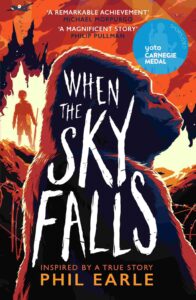
When the Sky Falls
It’s 1940. Joseph has been packed off to stay with Mrs F. She’s a real grump and owns a rundown city zoo.
He gets there and meets Adonis, a huge silverback gorilla.
But when the bombs start falling, Joseph has to guard the cage, and be ready to shoot Adonis if a blast sets him loose.
A nine-year-old could read every word of this book. That’s exactly why it’s the perfect example of check 3.
But I’d save it for 11. The hard part isn’t the words. It’s a boy holding a gun and hoping he never has to use it.
What age is Little Darlings for?
Little Darlings
Sunset is a rock star’s daughter living a life of luxury with no real friends. Destiny lives on a rundown estate with a mum who swears that same rock star is her dad. Then the two girls meet.
Classic Jacqueline Wilson. Simple to read, older in feelings. Fame, money and a maybe-dad are themes that suit 10 better than 8, even though an 8-year-old could manage the sentences. If you want the same call made across her whole shelf, I’ve ranked the best Jacqueline Wilson books with ages for each.
One for 10 and up.
The Hunger Games (or, when the answer is “not yet”)
Sooner or later a year 5 child announces that everyone in their class has read The Hunger Games. (Just so you know, ‘everyone’ has not.)
Katniss volunteers to take her sister’s place in a televised fight to the death. The reading level is fine from about 11. But the violence isn’t a side detail in this one, it’s the whole story, and the books wring every drop of fear out of it.
11 at the very earliest, and “not yet” is a perfectly good answer. It’s a brilliant series. It’ll still be brilliant next year. I’ve gone deeper on this one in what age is The Hunger Games book for.
Quick ages for more books parents ask about
A tonne of you are googling these too, so, rapid fire:
- Nate the Great – from 5. A boy detective solves neighbourhood mysteries with his dog Sludge. Brilliant first solo reads.
- Esio Trot – from 7. Roald Dahl’s shortest, sweetest one. Mr Hoppy schemes to win his neighbour’s heart via her tortoise.
- First Term at Malory Towers – from 8. Darrell starts boarding school, makes friends and loses her temper. The later books suit 9+.
- Boy Overboard – from 9. Jamal dreams of World Cup glory while his family flees Afghanistan by boat. Football on the surface, refugee story underneath.
- Wolf Hollow – from 11. A girl protects a shell-shocked loner when a cruel new classmate starts telling lies. An easy read with heavy themes, same rule as When the Sky Falls.
The age question, answered before you ask it
This whole article is basically the job i used to do at parents’ evenings.
“She’s finished everything, what’s safe to hand her next?”
It’s also the job Little Reads does for every single book.
All 3,000+ books in the library carry an age tag, decided by an actual human (it’s me, hi), so you can browse your child’s age and know everything there fits both halves of the question. The reading level AND the content.
No more squinting at back covers in a bookshop.
Quick note from me. We’re for kids who already love reading. If yours is still learning the mechanics of it, a phonics app will get them further, faster.