
“If it ain’t broke…” a saying that’s heard a lot in this house.
As someone who’ll happily hyperfixate (hello buzzword) on things, I relate hard to this topic.
For example:
- I’ll watch anything with Olivia Colman. She can do no wrong in my eyes. Apart from the ending of the latest series of The Night Manager because it BROKE ME IN TWO.
- My day hasn’t started until I’ve had a peppermint and liquorice tea and a coffee (at the same time).
- I’ve had the same chocolate and blueberry porridge for breakfast since Christmas.
So we’ve all got things we stick with. (Some of us more than others, hold your judgement please.)
Why your child only reads one author (and why it’s usually fine)
If your child only reads one author on rotation? You’re not alone. I used to see it all the time in my library lessons. The Dav Pilkey kids. The Jeff Kinney kids. The ones reaching for the same shelf every Wednesday.
Honestly though, sticking to one author isn’t always a bad thing.
They’re still reading. Maybe not widely, but they’re reading. And when a kid keeps going back to the same author off their own back, it doesn’t mean they’re not developing. It just means they’ve found one that clicks.
Basically the kid version of me watching every Olivia Colman thing on iPlayer. Comfort. Familiarity. A safe bet.
And that’s totally okay.
When it is worth a nudge
By ‘nudge’ I don’t mean stripping the bookshelf bare and replacing every book on it. That’ll probably backfire.
There are a few times though when leaving a new book out can actually help.
One. You might be here because your child has read everything that author has written and is now on a re-read loop. They’re ready for something else. They just don’t know where to look yet.
If the re-read loop is the real issue, we’ve got a separate piece on when your child re-reads the same book over and over that’s worth a look. Or if they’re stuck on Eoin Colfer? Our books like Artemis Fowl piece has the next five.
Two. The author’s range is pretty narrow. A child stuck on one Dahl book they love isn’t the same as a child working through the whole Dahl shelf. One is comfort. The other is settling.
If they’ve worked the whole shelf and are ready for the next big name, our piece on what to read after Roald Dahl is the natural next stop.
Three. The pattern’s gone on for over a year. Short obsessions are totally normal. (Hi, porridge.) But if it’s been that long and they still haven’t picked up anything else, showing them what else is out there probably won’t hurt.
That’s it. No need to lose sleep over it. Just keep half an eye out.
Author bridges I’d recommend
Most of these pairings work in reverse too. Already a Walliams kid? Dahl’s the obvious next stop. Already deep in Jacqueline Wilson? You can run the list backwards from there.
(Or go the other way: our piece on books like Jacqueline Wilson has a full shelf of next steps.)
If they love Roald Dahl, try David Walliams
The closest swap on the shelf. Same mischief, same affectionate rudeness, same short chapters with full-page illustrations breaking up the text. If your child loved Matilda for the underdog energy or George’s Marvellous Medicine for the grown-ups-as-targets humour, they’ll already get Walliams.
And if Walliams is the author they’re stuck on, our books like David Walliams list is the next stop.
Gangsta Granny is the one to start with. Ben is stuck at his Gran’s every Friday night. It smells of boiled cabbage. There are dentures floating in a glass by the bed. He’s bored stiff. Then Gran lets slip that her quiet little life has a slightly more interesting backstory than the cardigan and the cabbage soup suggested.
It’s silly. It’s a little bit rude. It also has a genuine lump-in-the-throat moment by the end without tipping into a sobfest.
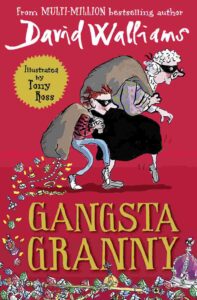
Gangsta Granny
If they love David Walliams, try Andy Stanton’s Mr Gum
A natural next step for a Walliams kid who wants the volume turned up. Stanton writes like a chaotic uncle making up a bedtime story as he goes. There’s a town called Lamonic Bibber. There’s an old man called Mr Gum who is lazy, rude, and possibly the worst person in town. There’s a fairy who lives in his bath and makes him keep the house tidy.
The plots are silly. The narrator interrupts. The chapter titles read like jokes. You couldn’t really call it a series in the normal sense. It’s more of a mood.
Start with You’re a Bad Man, Mr Gum. If your child laughs out loud at the first chapter, you’ve struck gold.
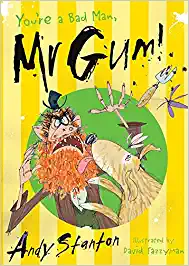
You’re a Bad Man, Mr Gum!
If they love Jacqueline Wilson, try Karen McCombie
Same emotion (friendship, family, school, the small dramas of being a kid in the middle of growing up) but less likely to ambush your child with heavy themes. McCombie writes warm, modern stories where everyone is just trying their best.
A good place to start is Angels in Training, which is low-stakes and gentle. If your child is already used to Wilson’s stronger stuff and wants something with more weight, Catching Falling Stars is set during WWII and goes deeper.
McCombie’s range is wide so there’s no single ‘try this one’ answer. Think of her shelf as a softer landing pad. Once they’ve worked through a few, Hilary McKay is the natural next move. The Casson Family books are sibling-sized chaos done with a lot of heart.
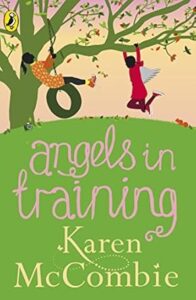
Angels in Training
If they love Liz Pichon (Tom Gates), try Jeff Kinney (Diary of a Wimpy Kid)
The format will already feel like home. Greg Heffley’s journal looks a lot like Tom’s. Doodles on every page, dialogue in speech bubbles, footnotes, comic strips. The plot is basically: a middle-school boy is trying to survive middle school and make his life slightly less embarrassing. He largely fails. It is very funny.
The main difference is the setting. Greg is American, so there’s middle-school lockers and Thanksgiving where there’d be year groups and the school play. Most kids barely notice. The jokes travel.
For chaotic-girl energy in the same comic-doodle format, Pamela Butchart’s books are the swap. Shorter, sillier, and there are loads of them to get stuck into.
If they’re already deep into Wimpy Kid and want to know what’s next, our what to read after Diary of a Wimpy Kid piece picks up from there. And if Tom Gates is the author they won’t move on from, our books like Tom Gates piece is the one to read.
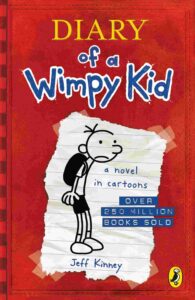
Diary of a Wimpy Kid
If they love Enid Blyton, try Robin Stevens’s Wells & Wong
Think of these as Malory Towers if someone had actually committed a murder. Same boarding school world (uniforms, dormitories, midnight feasts, lacrosse) but with a proper detective plot underneath. Daisy Wells is the showy English girl who runs the Detective Society. Hazel Wong is her best friend and the one keeping notes. The two of them solve crimes the staff would rather pretend aren’t happening.
And if Murder Most Unladylike is the series they can’t put down, our books like Murder Most Unladylike list lines up five more.
It’s still the 1930s but Stevens doesn’t airbrush the period the way Blyton does. Hazel is from Hong Kong and the racism she meets is on the page, handled carefully but not glossed over. Worth flagging that gently if your child is at the older end.
Start with Arsenic for Tea. Once your child is hooked, there are several more on the library shelf to work through.
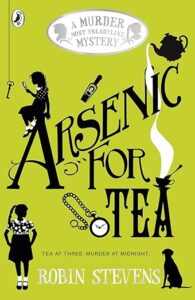
Murder Most Unladylike 2 – Arsenic for Tea
How to introduce them
We all know what it’s like trying to change. Adult or kid, it’s uncomfortable. Done in an obvious way it can go down like a lead balloon.
So keep it low effort.
Leave the new book somewhere they’ll trip over it. The kitchen table. The back of the car. The bedside pile. The bathroom if you’re being thorough. The point is they see it before anyone tells them to read it.
If you do mention it, keep it casual. ‘Have you seen this one? It’s a bit like [their favourite author].’ That’s all. No pitch, no Saturday-morning chat about reading widely. If they ignore it, fine. Leave it there. Move on.
Other formats work too. If there’s a film or TV show based on one of the new authors’ books, that’s an easy way in. Watch it together. Don’t make a big deal of the book afterwards.
The whole thing should feel like nothing. Because for them, it kind of is. They’ll get there in their own time.
(Some of us just take a bit longer to move on than others.)
A cheaper option
If you fancy lowering the stakes (and the cost) of introducing new books, all the authors named in this article are on Little Reads.
3,000+ hand-picked books, in fact. Easy to poke around in whenever they’re ready.
And one last honest thing. If your child is happy where they are and doesn’t want to budge yet, leave them to it.
Reading widely will happen on its own eventually.
Same way I’ll move on from the porridge (eventually).