
Should my child finish every book they start? Honestly, no. Not from what I saw in ten years of teaching English, and I watched a lot of children read (not in a weird way, it was literally my job).
We’ve all been there, haven’t we? You’re just not feeling the book you picked up, but part of you thinks you should push through because you went to the effort of borrowing it (or, even worse, buying it).
Now, as an adult you’ve obviously got free will (the same way you can have ice cream for dinner if you wish). And I’m of the opinion that life is too short, and there are far too many amazing books out there, for you to struggle through one you’re just not vibing with. Same way I don’t think anyone should deny themselves ice cream.
BUT. I’ve also had times when the struggle paid off. The book got good. I made it through the slow burn, got to the good stuff, and boy was it worth it.
How that lesson reaches a child is the tricky bit. Delayed gratification is something most grown-ups have made their peace with. Children haven’t, and it’s a hard one to navigate. So what follows isn’t advice (I don’t have children, and I was never a pushy recommender). It’s just what I saw.
What I saw when children gave up on books
One caveat before I get into it here. I’m not talking about kids who give up on books generally. That’s a different topic and perhaps something I’ll write about in the future. In that instance, it might be that reading itself hasn’t clicked yet, or they haven’t found the book that makes it click.
That’s not what I’m talking about here. I’m referring to something more specific. A child who does already (willingly) choose to read and enjoys it but they’re giving up on a book that you think they will actually enjoy if they just stick with it.
I definitely had times while I was teaching when I’d handed a child a book and, a chapter or a couple of pages in, they wanted to throw in the towel. Most of the time the book went back and something else came off the shelf. No real harm done.
What I saw far more often was the opposite. I had many occasions during my time teaching when some children just were not connecting with the text we were studying (especially when it came to GCSE texts…). In those instances it really felt like I was dragging students through books they were simply not enjoying, and as a result I watched any love or appreciation of reading fade away entirely.
That was devastating. (It’s also some of the reason I’m no longer a teacher today, but we’ll save that Pandora’s box for another day…)
And then you had the children who’d regularly pick the books with too many pictures, or too many jokes. Books with no “depth”, as I heard some people say. To which I’d say, “but they’re reading, aren’t they?” And that’s all that ever mattered to me. (I’ve since put that whole argument in one place, in the books teachers are sniffy about, five from our age 9 shelf that children rate and nobody reviews.)
Ten years in one line, then. The children who read the most were not the ones who’d been made to finish things.
The one time it’s worth a closer look
That said, I did see the slow burn pay off once.
I had a child who’d really enjoyed studying Once by Morris Gleitzman (it’s on our free shelf, at the older end, 11 and up) and was thrilled to learn there was a whole series. But when he first started on Then, the second book, he didn’t enjoy it.
I wasn’t ever a pushy recommender, but I did suggest he give it a couple of chapters. Lo and behold, it clicked.
On that occasion it worked out. And the difference, as far as I could ever tell, was that he’d loved the first one. He had a reason to trust the second. That’s a very different thing from being three pages into a book he’d never chosen and never wanted.
So the closer look, for me, was always the same question. Did they pick it? If they did and it’s gone quiet, sometimes the good stuff is a chapter away. If they didn’t, it’s usually just the wrong book. (And if they only ever pick one author, that’s a whole other article.)
Five books that get going fast (so nobody has to push through)
Chosen for pull, not for improvement. Every one of these starts a series we stock, so if they vibe with it, there’s plenty to tuck into.
I Survived the Great Chicago Fire, 1871 by Lauren Tarshis
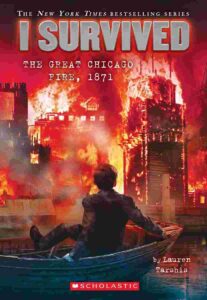
I Survived the Great Chicago Fire, 1871
Could an entire city really burn to the ground? Oscar Starling never wanted to come to Chicago. But then Oscar finds himself not just in the heart of the big city, but in the middle of a terrible fire. No one knows exactly how it began, but one thing is clear. Chicago is like a giant powder keg about to explode.
Short, fast and standalone. We stock fifteen, from Pompeii to the Titanic to a tsunami in Japan, and a child can start with any of them. Age 9.
Melvin Beederman, Superhero: The Curse of the Bologna Sandwich by Greg Trine
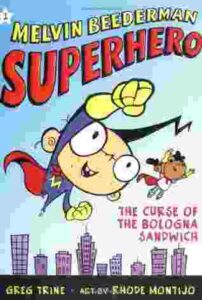
Melvin Beederman, Superhero – The Curse of the Bologna Sandwich
A superhero who takes five or six goes to get off the ground. Relatable.
Meet Melvin Beederman. He’s a pretty good superhero, even though it always takes him five or six tries to get launched and flying. His weakness (every superhero has one) is bologna, which makes it hard to go into a deli. Still, Melvin manages to keep the city of Los Angeles free of nasty villains, once he’s airborne. Crash! Splat! Thud! Kabonk!
The too-many-jokes book, and proudly so. Age 7.
The Demon Headmaster by Gillian Cross
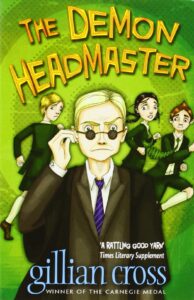
The Demon Headmaster
Pupils talking like robots and a headmaster with a secret.
Dinah moves in with the Hunter family and starts going to the same school as her foster-brothers Lloyd and Harvey. It’s not easy, as they seem to hate her, and school is really strange. Pupils suddenly talk like robots and do weird things (even Dinah finds herself acting oddly). She’s sure the headmaster has some kind of power over them, and is determined to find out more. But the Demon Headmaster is equally determined to stop her.
We’ve got six of the series. Age 8.
My Teacher is an Alien by Bruce Coville
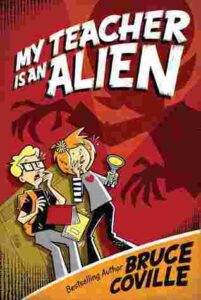
My Teacher is an Alien
She catches him peeling off his face. No biggy.
Susan Simmons can tell that her new substitute teacher is really weird. But she doesn’t know how weird until she catches him peeling off his face and realises that “Mr Smith” is really an alien. At first no one will believe her except Peter Thompson, the class brain. When Peter and Susan discover Mr Smith’s horrible plans for their classmates, they know they have to act fast.
We’ve got four of the series. Age 8. My book series for 8 year olds list has five more that go on for a while.
My Dog is Better than Your Dog (Crime Biters book 1) by Tommy Greenwald
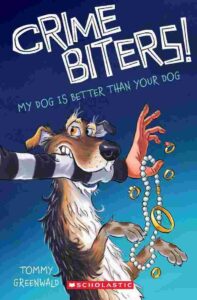
Crime Biters 1 – My Dog Is Better Than Your Dog
Jimmy Bishop loves three things. Laughing at funny dog videos online, watching his favourite show (Stop! Police!) on TV, and reading his favourite vampire book (Fang Goodness) over and over. His self-involved older sister and workaholic mum think he needs to stop obsessing already. But when his dad finally allows Jimmy to get a puppy before school starts, everything changes. His amazing dog Abby seems to have some very unusual habits. She sleeps all day but is wired at night, and she runs from the garlic kelp biscuit made by Jimmy’s strange new babysitter Mrs Cragg. Could she possibly be… a vampire?
This one is on our free shelf and there’s three more after it. Age 9. (If the re-reading bit sounds familiar, I wrote about that too.)
A few more in the same vein
The Smidgens by David O’Connell (three-inch-tall people under a village, age 9, first of three). You Can’t Make Me Go To Witch School! by Em Lynas (age 9, first of three, and the title tells you the tone). And if I Survived lands, Survivor Diaries: Overboard! by Terry Lynn Johnson does the same job on a capsized whale-watching boat (age 9, first of four).
If what they need first is shorter chapters, my chapter books for 7 year olds and for 8 year olds are the place to start.
Just so you know…
Every book on this page is in Little Reads, which is the library app my husband and I built for exactly this kind of reader. The one who’s put a book down and wants the next one now. It’s 3,000+ hand-picked books, £7.99 a month after a 7-day free trial, cancel anytime. A free account comes with 100+ free books, and Crime Biters and Once are both in that hundred.
The honest line, as always. It’s a library, not a lesson. No levels, no tests, and nothing that makes a child finish a book before they can open another. If they abandon one at chapter two, the shelf is right there.