
Read Pippi In The South Seas free for 7 days. £7.99/month after - less than a paperback.
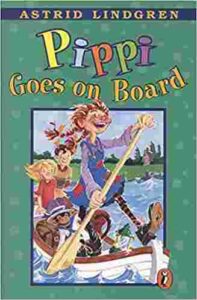
Pippi in the South Seas by Astrid Lindgren is a story for 6 year olds about a girl who lives on her own and refuses to be impressed by anybody.
Pippi's house is called Villa Villekulla. The garden is a jungle, the lawns have never been cut, there is a horse standing on the veranda and a monkey called Mr Nilsson on her shoulder.
It opens with a very grand man in a very grand car deciding to buy the place. Polished shoes, a gold ring, and a horn he honks so people will look at him.
He calls the house a miserable hovel. He announces he will chop down the old oak.
Tommy and Annika are horrified. It is hollow, they explain, so you can play inside it. Also soda grows in it. And chocolate, on Thursdays.
He tells them they have been sitting in the sun too long and asks to speak to the owner. Pippi carries on skipping and says the owner is terribly busy, but he is welcome to wait.
It is a string of separate afternoons rather than one long story, good for a chapter at a time.
The best one is Miss Rosenblom. She is a rich old lady who turns up at the school once a term to hand out coins and sweets, and underwear to the poorest children. First she tests everybody. The whole town is frightened of her.
Annika's hair bow quivers while she queues. Tommy goes whiter the nearer he gets.
Then Pippi shoves her way to the front. Asked to spell seasick, she offers S-e-e-s-i-k and suggests the dictionary be corrected. Asked when King Charles the Twelfth died, she says oh dear, is he dead too. Asked why horses have dark markings in their molars, she points at her own horse and suggests asking him.
That is the whole pleasure of her. Pippi is never once flustered. Everybody else is, constantly. And she is not being clever, she genuinely cannot see why any of it matters.
She also invents a word, spink, purely because she likes the sound of it, and then goes out looking for something it might turn out to mean.
Pippi's father is king of an island in the South Seas, and the letter he sends summons her out there as Princess Pippilotta, with his faithful subjects waiting to greet her. That is what the second half of the book is built on, and it is written the way that idea used to be written.
If that is something you would rather talk about than let go by, better to know now. If you are reading it together anyway, the first half is Pippi at her most gloriously unbothered.
For another grown-up who is nothing like a normal grown-up, try Marge and the Secret Tunnel. Marge arrives to babysit in a full ski-suit, claims to be royalty, and describes finding a solid gold unicorn horn under the palace.
A library hand-picked by an English teacher, delivered through a calm, ad-free app. If your child already loves reading, we keep up.
7-day free trial. Then £7.99/month.