
Everyone has a list of classic children’s books they think a child ought to read. Not all of them still get picked up, though.
So this is every classic we stock, sorted by age from 5 to 11. For each one I’ve said whether it’s a book a child can take off and read alone or one that works better out loud with a grown-up (with the old ones, that’s usually what you need to know).
Whilst I was teaching, the term ‘classic’ often took on a different form. Some felt that it was a canonical text like a Steinbeck or Angelou and others would say that Harry Potter was a classic. I mean considering it’s nearly 30 years old now I suppose we could start putting it as a classic.
But I think that a classic text has more of an emotional connection than we think. For me, I’d put classics down as Roald Dahl’s Matilda or even The Tiger Who Came to Tea. But these are all books I distinctly remember from my own childhood. Laughing at my dad’s feigned shock at a tiger who could potentially drink his beer and being totally in awe of Matilda’s magical powers.
And I have to say I did still see children reach for Roald Dahl and the silliness still got a laugh. And I know that The Tiger Who Came to Tea was also a popular book with some of our early years classes. I loved reading The Twits aloud to my students during my time at the SEND school. All of them would be in fits of laughter at their horrible tricks and disgusting appearances.
So, a classic children’s book doesn’t have to have been critically acclaimed or won a tonne of awards. I think a classic children’s book is simply something that has aged kinda well (e.g. not too much in it that makes you wince today) and draws in a child.
The classic children’s books we stock, by age
The age is the one on our shelf, so a few might surprise you (Alice is at 11, and The Wind in the Willows is at 8).
| Book | Age on our shelf | Worth knowing |
|---|---|---|
| The Owl Who Was Afraid of the Dark (Jill Tomlinson) | 5 | One chapter a night |
| Paddington (Michael Bond) | 5 | The film’s version of his story |
| Charlotte’s Web (E. B. White) | 6 | A read-together one, with sad bits |
| Pippi Longstocking (Astrid Lindgren) | 6 | No parents and a horse on the porch |
| The Worst Witch (Jill Murphy) | 7 | A wonky broomstick and a tabby kitten |
| The Sheep-Pig (Dick King-Smith) | 7 | A piglet who wants a sheepdog’s job |
| The Wind in the Willows (Kenneth Grahame) | 8 | Slow river chapters, then Toad |
| Stig of the Dump (Clive King) | 8 | A caveman at the bottom of a chalk pit |
| The Little Gentleman (Philippa Pearce) | 8 | A talking mole in a meadow |
| The Lion, the Witch and the Wardrobe (C. S. Lewis) | 8 | Brilliant read together at bedtime |
| The Iron Man (Ted Hughes) | 9 | Short, good over a few bedtimes |
| A Little Princess (Frances Hodgson Burnett) | 9 | One hard chapter a third of the way in |
| The Animals of Farthing Wood (Colin Dann) | 10 | A survival story, sad in places |
| Watership Down (Richard Adams) | 10 | Not a cosy bunny book |
| Just So Stories (Rudyard Kipling) | 10 | Short, and very much of its time |
| The Hobbit (J. R. R. Tolkien) | 11 | Start it together |
| Alice in Wonderland (Lewis Carroll) | 11 | The wordplay suits an older reader |
Each age has a page of its own too, from books for 5 year olds up to books for 11 year olds, if you’d like to see the whole shelf and not just the old ones.
Classic books for 5 and 6 year olds
Almost everything at this end is a read-aloud.
Charlotte’s Web opens with Fern grabbing hold of her father’s axe to save a runt piglet, and there are sad bits later on you might want to talk through together. Pippi Longstocking has red pigtails, no parents to tell her what to do and a pet monkey called Mr Nilsson.
Our Paddington is the film’s version of his story (Peru, the Browns at the station, and an evil taxidermist who’d love to come between him and the Browns). And if it’s the reading-together bit you’re after, my family read aloud books list has plenty more.
The Owl Who Was Afraid of the Dark by Jill Tomlinson
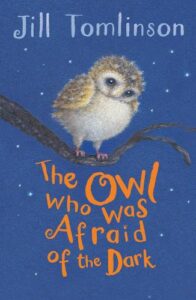
The Owl Who Was Afraid of the Dark
For the child who calls down the stairs about the landing light.
Plop is a baby barn owl, fat and fluffy with very knackety knees, and he thinks the dark is nasty. His mother points out that he doesn’t actually know anything about it, and sends him down out of the nest to find out.
Each chapter is one meeting and one new idea about the dark, so it’s easy to stop at the end of one and pick it up tomorrow night. 5 on our shelf.
Classic books for 7 and 8 year olds
8 is where most of our classics sit, and where more of them start to work as something a child reads alone. You’ll find the rest of that age on books for 8 year olds.
Stig of the Dump by Clive King
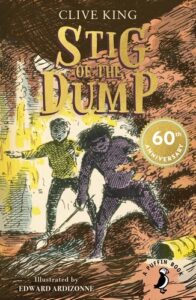
Stig of the Dump
For the child who’d rather be outside.
Barney spends a lot of time by himself. One day he’s exploring the edge of an old chalk pit when it gives way, and he lands in some sort of cave. Living down there is a somebody with a lot of shaggy hair and two bright black eyes, wearing a rabbit skin and speaking in grunts.
Barney’s first thought is that it’s a funny way to dress (rabbit skins round the middle and no shoes or socks), which tells you exactly the kind of boy he is.
The Sheep-Pig by Dick King-Smith
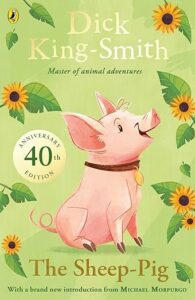
The Sheep-Pig
For the child with a soft spot for the underdog.
Farmer Hogget wins Babe at the village fair by guessing his weight. Fly the collie decides to mother him, and soon Babe is asking why a pig can’t work sheep if her puppies can.
Then he learns something no dog has bothered to find out. Sheep hate being bossed about. 7 on our shelf.
The Wind in the Willows is at 8 too. Mole and Rat are happy pottering about in a rowing boat, but Toad has already wrecked seven motor cars and ends up in the remotest dungeon of the best-guarded castle in the land. The river chapters are slow, and the Toad ones are what they’ll ask for again.
The Lion, the Witch and the Wardrobe sits here as well. If they get through all seven, my books like Narnia list picks up where Lewis stops.
In The Little Gentleman by Philippa Pearce, Bet is asked to read aloud in a meadow to nobody at all, and her audience turns out to be a mole who can talk and is over three hundred years old.
The Worst Witch is a year younger at 7 (Mildred Hubble, a broomstick mended with sticky-tape and a tabby kitten that keeps falling off the end of it).
Roald Dahl and Enid Blyton both have pages of their own, so I haven’t squeezed them in here. My best Roald Dahl books and best Enid Blyton books lists go through them by age and series.
Horrid Henry and Goosebumps feel like classics if you grew up in the 90s. They’re on my book series from the 90s list.
Classic books for 9, 10 and 11 year olds
From 9 up, the classics get longer and the language gets older. A few of them have frightening bits too.
The Iron Man by Ted Hughes
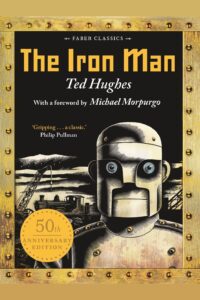
The Iron Man
A short, strange one about a giant made of iron.
Nobody knows where he came from. In the very first chapter he steps off a cliff and smashes to pieces on the beach below. Then one of his hands finds one of his eyes, and bit by bit he puts himself back together.
Soon tractors and ploughs start to disappear, and it’s a farmer’s son called Hogarth who first spots him.
It’s short, so it’s a good one to share over a few bedtimes. Our edition calls him the Iron Giant and uses American spellings. 9 on our shelf.
The Hobbit by J. R. R. Tolkien
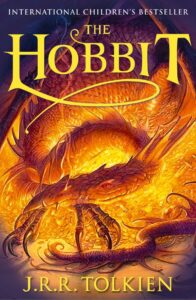
The Hobbit
A long adventure about somebody who really doesn’t want one.
Bilbo Baggins lives in a hobbit-hole (round green door, brass knob in the exact middle, pantries plural), and Bagginses do not have adventures. Then a wizard turns up at the door and won’t go away. The next day thirteen dwarves arrive, eat his seed-cakes and send him running to the pantry.
What finally gets him out of the door is overhearing a dwarf say he looks more like a grocer than a burglar.
The first chapter is basically one very long tea party, and the narrator chats away and wanders off into side stories. It’s one to start together and hand over once they’re hooked. 11 on our shelf.
The Animals of Farthing Wood (10) starts with the last pond being filled in. Badger calls an Assembly, Toad stumbles in with news of a nature reserve called White Deer Park, and every animal swears an oath to protect the others on the way there. The journey brings fire, storms and hunters.
Watership Down is at 10. Fiver, the smallest rabbit in the warren, gets a terrible feeling about a new board by the gate, and a handful of rabbits slip away one moonlit night. It isn’t a cosy bunny book. The rabbits fight with teeth and claws, there’s blood, and there’s one old phrase about race that really jars today.
Just So Stories (10) is how the Leopard got his spots and how the Elephant’s Child got his trunk, told the way Kipling told them to his own children. The language is very much of its time.
A Little Princess sits at 9, and Sara Crewe goes from the best room in the school to the attic in a single chapter (a hard one).
Alice in Wonderland is at 11 on our shelf, which surprises people. The Mad Hatter and the Cheshire Cat are fine at any age, but the wordplay lands better with an older reader.
And Harry Potter and the Philosopher’s Stone sits at 11 here (I taught it every autumn term, it’s so wonderfully festive).
There are more Christmas stories for 9 and 10 year olds on my Christmas books for 8 year olds list.
The classics we don’t have (yet)
A few big names are missing. The Secret Garden, Peter Pan, Black Beauty, Heidi, The Railway Children and The Borrowers aren’t in Little Reads yet, and they’re the ones I’d most like to add.
Just so you know…
Every classic on this page is in Little Reads. A free account has 100+ free books. The whole library is 3,000+ hand-picked books, £7.99 a month after a 7-day free trial. Cancel anytime.
It’s a library, so there are no quizzes and no reading levels. For the child who already loves a story and doesn’t mind a book that’s older than they are, there’s a lot here.