
“Are we there yet?” A question banned on long car journeys up to Scotland when I was a kid.
We were one of those families where the only person allowed to talk was the radio. Everything else was banned.
Thank goodness I had my Walkman, a stack of books, and a generous supply of cheese and ham sandwiches.
I learnt fast. Books for car journey kids are their own special category. The wrong one lasts about ten minutes.
I was also one of those kids who had to switch between music and reading, because my mum liked the brake pedal a little too much. The kangaroo hopping down the road was enough to make even the strongest stomachs a little queasy.
So reading in the car? Definitely not for everyone. Some kids spend the whole journey lost in a book. Others can’t glance at Google Maps without going a little green. I sit somewhere in the middle.
This is where the right books really earn their spot. Sharp, short-chaptered, packed with action.
Books that can forgive an unplanned service station wee break, or a dreaded three-mile traffic jam on the M6. The kind of stories where your child doesn’t lose their place even if you do.
Long car journeys also reward standalone books. The kind that feel complete on their own. They can be picked up and dropped at any occasion. They can even be passed down the back seat to a sibling.
These five grip from the first page. I’ve deliberately left the slow tear-jerkers for a rainy afternoon.
No one wants to be sobbing into their sleeves 20 miles in.
If you want those slower reads for that kind of day, our piece on what to read on a rainy weekend afternoon is where they live.
What to look for in books for car journeys
Before we get to the picks, here’s what makes a great car-journey book actually work:
- Standalone stories, or self-contained enough to feel complete on their own. Avoids any meltdowns at the Welcome Break because you don’t have book 2.
- Strong page-turners with a “what happens next” hook at the end of every chapter.
- Short chapters for stop-start reading (service stations, the youngest needing a wee, traffic). The book has to forgive interruptions.
- Light-ish subjects. A bit of feeling is fine. A proper sob fest at hour four of the M6 is asking for trouble. No one wants to be passing tissues across the gear stick.
Short chapters also work brilliantly for bedtime, by the way. If that’s your other situation, our short-chapter bedtime list is there for you.
The other thing worth thinking about is motion sickness. Most kids who are mildly affected can still manage. They just need a book gripping enough to forget the road.
But for those who absolutely can’t read in cars, stick to your music and save the reading for when you get there.
Or scroll to the honourable mentions. There’s a read-aloud option down there.
Right. The picks.
Five standalone books made for the car
Holes by Louis Sachar
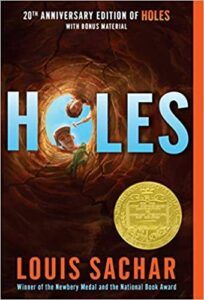
Holes
For the child who works out the killer halfway through an episode of Sherlock and then waits, smug, for everyone else to catch up.
Once you start Holes, you have to finish it. It’s plotted like a puzzle. Click the last piece into place at hour four and that’s the feeling you want.
Stanley Yelnats is sent to a brutal juvenile detention camp where the boys dig holes all day. There’s a curse on his family. There are stories within the story. Flashbacks layer in and the pace never sags.
It’s funny. It’s dry. It’s not heavy emotionally. And the ending serves as a great discussion piece.
Expect your 10-year-old to retell the curses-and-onions plot at the petrol station. Then carry on for another two chapters once you’re back in the car. You’ll get to your destination with everyone in one piece. Still talking about it over chips.
The Boy at the Back of the Class by Onjali Q. Raúf
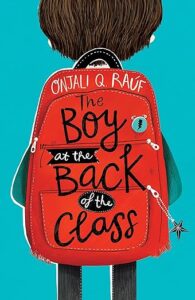
The Boy at the Back of the Class
A book full of hope, told in a child’s voice so warm you can almost hear it next to you in the back seat.
The Boy at the Back of Class is about a new boy in school who turns out to be a refugee, and the friends who decide to do something about it.
Chapters are short. Self-contained. The narrator’s voice forgives any number of interruptions.
It might give you a lump in your throat but no one’s going to be reaching for tissues (important when you’re stuck in a car with limited resources).
The talking points keep coming long after the engine’s off.
And it’s the kind of book a 9 or 10-year-old will quietly remember. The type they’ll bring up out of nowhere on a different long car journey when they’re 14.
If real-life stories like this one are exactly what your child loves, our piece on books like Jacqueline Wilson is full of them.
Kensuke’s Kingdom by Michael Morpurgo
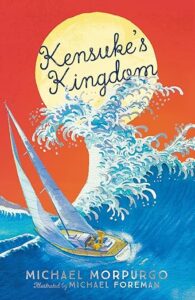
Kensuke’s Kingdom
Want the slow, quiet kind of adventure? Kensuke’s Kingdom is the one for that.
Expect the salt air to come right off the page. A boy washed up on a desert island. A quiet old man who’s already there. And a story that unfolds at exactly the right speed.
It’s a short book that you can finish it on a single long drive.
Morpurgo writes in a way that pulls in children and adults at the same time. In my opinion, this is a rare kind of book where nobody in the car gets bored.
Works as a read-aloud too, if you’re driving and want everyone in on it. And if you’re not sure your nine-year-old is ready for it, my guide to the best Michael Morpurgo books has an honest age for every one of his.
Plus, if you’re heading somewhere coastal this summer, even better.
The London Eye Mystery by Siobhan Dowd
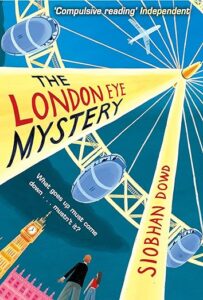
The London Eye Mystery
If your child has already powered through Robin Stevens’s Murder Most Unladylike series and wants something with a different sort of brain behind it, this is the one.
For five more in that vein, our books like Murder Most Unladylike list is the place to go.
A boy goes up the London Eye. He never comes down. Try not opening The London Eye Mystery after that.
Each chapter serves up a mystery that is very satisfyingly resolved before moving on to the next. Self-contained, but not thin.
The narrator, Ted, has Asperger’s, and tells the whole thing in first person. His voice is dry and distinctive. It pulls you in the way most mysteries don’t (and it’s a lovely discussion point for a family chat later).
Expect your 11-year-old to be quietly working out the solution before Ted does. Which is exactly the right kind of car-journey energy.
Bonus: if London is the actual destination, it doubles as a holiday primer.
Wonder by R.J. Palacio
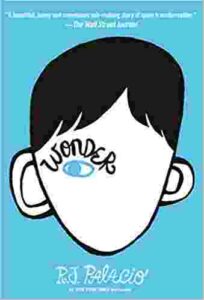
Wonder
If your child’s the kind of reader who quietly looks up from the page and stares out of the window for a minute, Wonder is the one to pack for the long haul.
It tells the story of August, a boy with a facial difference, starting school for the first time. The chapters rotate between his perspective and the people around him. The book naturally reads like a series of episodes. Brilliant for stop-start journeys.
Yes, it’s emotional. But it’s life-affirming rather than crushing. You won’t be ambushed by grief at junction 19.
And if your child finishes before you’ve reached the destination, 365 Days of Wonder and the spin-offs are right there waiting.
A few honourable mentions
Three more, for the sub-situations:
- For a younger reader (gentler end of the age range): The Tale of Despereaux by Kate DiCamillo. Lyrical, episodic, reads like a bedtime story. Chapters are tiny. The book takes interruptions kindly.
- For pure, unhinged silliness: anything by Pamela Butchart. Her school-chaos series is short, illustrated, and ridiculous in the best way. Good if your child wants to laugh out loud rather than feel things.
- For the carsick reader: Morpurgo on audio. War Horse, Why the Whales Came, Private Peaceful. The audiobook versions are excellent. No one has to look down at a page. Kinder on a queasy stomach.
Pack the books, leave the rest
Long car journeys don’t have to be horrendous if you’ve got the right book.
And if you’re planning a proper summer of reading not just the journey, our summer reading list is the next thing to look at.
But if you’re anything like my mum was in the 90s, the boot’s already too full, you’re swapping out towels to make room for paperbacks, and someone’s crying about a missing flip-flop.
With Little Reads, you don’t need to swap anything out. All five (and the honourable mentions) are in the library, alongside 3,000+ hand-picked books. £7.99 a month after a 7-day free trial. Cancel anytime.
Honest caveat: if your child only reads non-fiction, this isn’t your app. We’re fiction-first.